The building most visitors walk straight past
Almost everyone who comes to the Royal Pavilion arrives with the palace in mind and leaves with the palace in their eyes, and a good many walk out through the gardens without registering that the long building on the north side of the estate is a museum, that it is a very good one, and that it stands there for reasons directly connected to the palace they have just seen. Brighton Museum and Art Gallery is not an appendage to the Pavilion. It is the other half of what happened to a royal estate once the royal family had finished with it, and it is the best hour a visitor can spend after the state rooms.
How a museum came to be on a royal estate
What the town bought
When Queen Victoria sold the Pavilion estate to the town of Brighton in 1850, the corporation acquired far more than a palace. It acquired William Porden’s stable complex, a riding house, service buildings, yards and gardens, all of which had been built to support a royal household that no longer existed. The town had to decide what a Victorian borough should do with them.
The answer was thoroughly of its time: turn them over to public improvement. Over the following decades the rotunda became a concert hall, the riding house became a corn exchange, and part of the remaining estate buildings was adapted to house a museum, an art gallery and a free public library. The museum opened to the public in the 1870s, and was reordered again in the early years of the twentieth century when the library eventually moved to premises of its own.
Why that history is visible
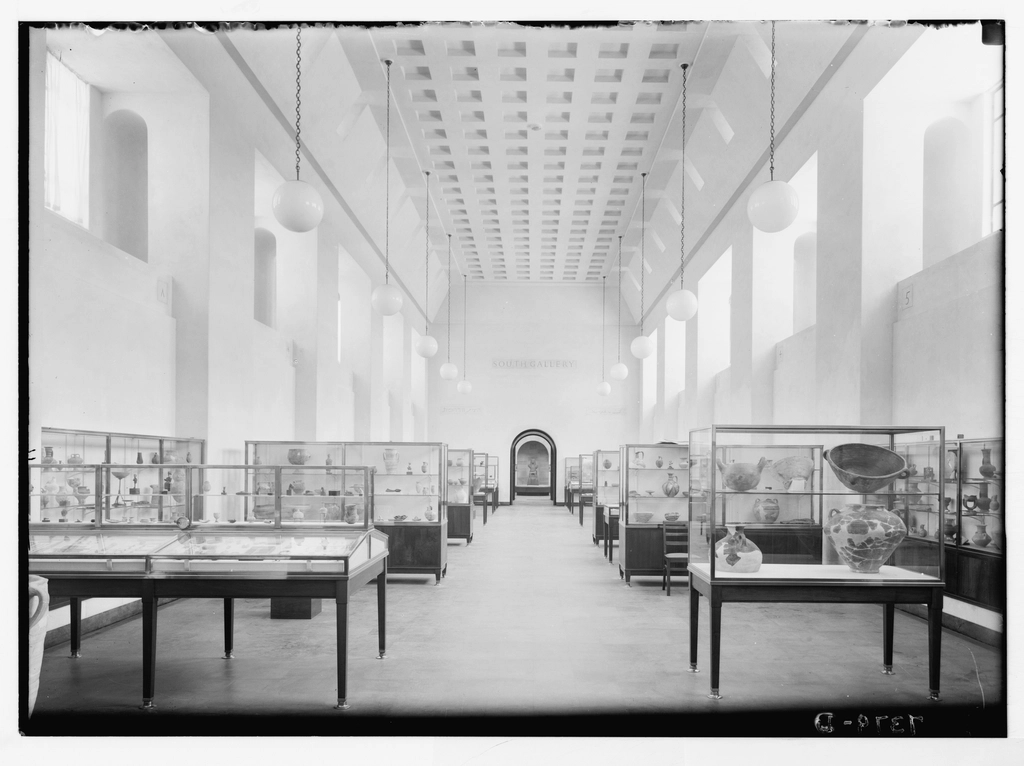
The result is a museum that does not look like a purpose-built museum, because it is not one. It is a set of adapted service buildings with a civic front applied to them, which is why the plan is a little unexpected and why the galleries sit on more than one level around a central space. Once you know that horses were once housed within a few yards of the fashion gallery, the building becomes considerably more interesting.
What the collections cover
Fashion and style
Brighton holds a strong costume and fashion collection, and it is displayed with unusual intelligence: not simply as a parade of frocks, but as a way of asking why people dressed as they did and what it cost them. Regency visitors will find the dress of the Pavilion’s own period here, which makes the gallery an excellent companion to the state rooms. There is also twentieth-century and contemporary material, and the museum uses its seaside city’s taste for self-presentation as a running theme.
Decorative art and twentieth-century design
The design collection is the museum’s calling card among specialists. It is particularly strong on the decorative movements either side of 1900 and on the interwar years: Art Nouveau furniture and metalwork, Arts and Crafts pieces, Art Deco, and Modernist and post-war design. Among the objects that stop visitors is a sofa made in the form of a pair of lips, to a design associated with Salvador Dali — a thing that manages to be both a joke and a serious piece of Surrealist furniture, and which sits very comfortably in a town that has never been embarrassed by display.
Pottery, and a collector with an argument
The Victorian collector Henry Willett gave Brighton a collection of English pottery assembled on an unusual principle. Rather than gathering the finest wares, he collected pieces that illustrated popular British history and belief: royalty, politics, sport, religion, crime, war and superstition, as they appeared on the mantelpieces of ordinary households. It amounts to a social history told through mugs and figures, and it is one of the most quietly rewarding displays in the building.
World art
The world art collection holds material from Africa, Asia, the Pacific and the Americas, much of it brought to Britain during the imperial period. The museum has spent years rethinking how such objects are shown, and the gallery now deals openly with questions of how things were acquired, who made them, and what they meant in the places they came from. For anyone who has just walked through rooms full of European fantasies about Asia, it is a pointed and useful counterweight.
Archaeology, Egypt, and Sussex
There is an archaeology gallery drawing on the exceptionally rich prehistoric and Roman record of the South Downs, and a display of ancient Egyptian material of the kind that Victorian subscribers and travellers brought back to provincial museums across the country. Both are modest in scale and generous in explanation.
The town’s own story
Finally there is the local history material, which is the reason to come if you want to understand the town rather than the palace: the fishing community that preceded the resort, the growth of the seafront, the piers, the railway and the day-tripper, entertainment and disreputability, wartime, and the modern city. The museum has been notably willing to give space to histories that older civic institutions left out, including the city’s long and important LGBTQ+ history, developed in partnership with the communities concerned rather than written about them from a distance.
The way the museum handles its own history
- It admits where things came from. Labels increasingly explain how objects were acquired, including acquisitions connected to empire, and do not present a collection as though it had simply appeared.
- It works with communities. Several displays have been co-curated with the people whose history is on show, which changes both what is selected and how it is described.
- It belongs to a family of sites. The museum, the Royal Pavilion and the city’s other museums are run together by a single charitable trust, so a visit here is part of the same organisation that cares for the palace.
- It changes. Galleries are reinterpreted, temporary exhibitions come and go, and displays close for redevelopment. What was in a particular room five years ago may not be there now.
How to spend an hour here after the Pavilion
The temptation after the state rooms is to feel that you have seen enough gilding for one day. Resist it, and use the museum to answer the questions the Pavilion raises but cannot address.
Start with the fashion gallery, because it puts clothes on the people you have just been imagining in the Banqueting Room, and Regency dress explains a great deal about how those rooms were used: how people moved, how hot they were, what could be worn near a fire and what could not. Move to the decorative art displays, where the same instincts that produced Crace’s dragons reappear a century later in Art Nouveau tendrils and again in Art Deco geometry; the Pavilion stops looking like an aberration and starts looking like one point on a long British enthusiasm for designed excess. Then take the local history material, which supplies the town that made the palace possible and the crowds that inherited it. If you have any time left, the world art gallery is the room in which to think again about what the Pavilion’s chinoiserie was actually doing.
Practical notes
The museum stands within the Pavilion estate, a short walk from the palace entrance across the gardens, and it is close to the Dome, the Corn Exchange and the shops of the North Laine. Admission arrangements, opening days, ticket combinations with the Royal Pavilion and any concessions for local residents have all changed more than once in recent years, so check the current information before you set out rather than relying on an older guide.
Allow an hour if you are pressed and two if you are not. The galleries are not large, but they are dense, and the museum rewards the sort of visitor who reads labels. There is seating, and after the standing and shuffling of a palace tour that is not a small consideration. Anyone with mobility needs, or travelling with children, will find it worth looking up the museum’s own access information in advance, since the adapted building has more levels than a purpose-built gallery would.