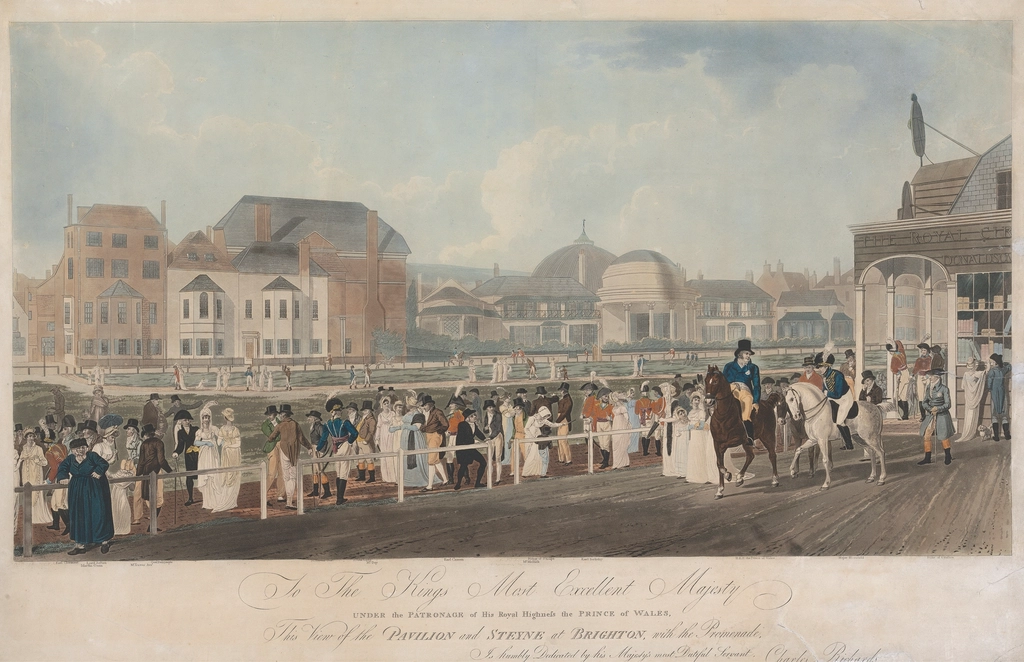
A Town That Bought a Palace
Almost every great house in Britain has passed from one private hand to another, or from a family to the National Trust, or from an owner to the taxman. The Royal Pavilion took a different route. In 1850 it was bought outright by the town of Brighton, using public money raised from local ratepayers, and it has belonged to the town ever since. That single fact shapes everything a visitor sees today. The Pavilion is not a royal palace open to the public by royal permission; it is a municipal building that happens to have been built for a king, and its survival is a story about committees, borrowing powers, local Acts of Parliament and a good deal of civic nerve.
The story is usually told as an episode in the life of Queen Victoria, who disliked the place and got rid of it. That is the shortest version and it is not wrong, but it leaves out the more interesting half. Somebody had to be willing to buy. Somebody had to decide what an emptied, unloved, expensively decorated shell in the middle of a seaside town was actually worth, and what a town could possibly do with it. Those decisions were taken by men whose names are now known mainly to local historians, and they were taken against real opposition.
The Crown Decides to Sell
By the late 1840s the Pavilion had stopped being useful to the monarchy. It had been built for a bachelor prince and enlarged for a childless king, and it did not suit a sovereign with a growing family in a town that had grown up tight around its walls. The Queen made her last visit in the mid-1840s, and the government of the day began to consider what to do with a large ornamental building it no longer needed and could not easily let.
Demolition was a genuine possibility. Brighton was expanding fast, and a cleared plot of several acres in the middle of a fashionable resort would have sold readily for building land. What stopped that outcome was less a conviction about architecture than a piece of local politics: the town realised that if the estate were broken up for building, Brighton would lose its largest open space, its most conspicuous landmark, and a substantial part of its reason for being visited at all.
What Was Taken Away First
Before the sale, the building was stripped. This was not vandalism but ordinary practice: the Crown was disposing of a property, not a collection, and the contents belonged to the sovereign. Wagonloads of material went to London and to Windsor over a period of months.
The scale of the removal
The removal went far beyond furniture, and it fell into three broad categories.
- Fixed decorative work. Chimneypieces were prised out of the walls and doors unhung, leaving gaps that had to be made good with plain joinery.
- Lighting and textiles. The chandeliers, wall coverings and carpets that gave each room its colour were lifted together, so the schemes lost their unity at a stroke.
- Purpose-made furniture. Cabinets and seat furniture designed for particular alcoves went into store or into other royal houses, where some of it can still be traced.
Rooms designed as complete decorative environments were reduced to painted boxes.
What survived
What could not be prised out generally stayed: the plaster ceilings, the painted and gilded surfaces applied directly to the walls, the ironwork of the structure, the great kitchen fittings, and above all the shell itself, which was too idiosyncratic to be worth anything except where it stood. It was this that the town bought — the architecture without its furnishings, a set of extraordinary rooms in a state that struck contemporaries as forlorn.
The Commissioners and Their Gamble
Brighton at the time was governed by a body of town commissioners rather than a modern borough council, and their powers were limited by statute. To buy a large property and take on the debt to pay for it, they needed specific parliamentary authority, and they obtained it through a local Act. The purchase price was substantial for a mid-Victorian town of Brighton’s size: the figure generally cited is in the region of fifty thousand pounds, a sum that had to be borrowed and serviced out of the rates for years afterwards.
The proposal was put to the ratepayers, and it divided them. The case against was straightforward and, on the numbers alone, strong. The town had pressing needs in drainage, water supply and paving. Ratepayers were being asked to pay for a pleasure house they had not asked for, whose upkeep would be permanent and whose usefulness was unproven. The building was expensive to heat, expensive to roof and, having just been emptied, had nothing in it.
The case in favour was speculative in the proper sense: it was an argument about the future. Brighton lived by visitors. The Pavilion and its grounds were the visible sign of the town’s connection with fashion, and the grounds themselves were an amenity that could never be recreated once built over. Buy the estate, the argument ran, and the town keeps its gardens, its landmark and a set of large halls it can use for its own public purposes. The vote went the way of the buyers, and the town took possession.
Putting a Palace to Work
Having bought it, the commissioners had to justify it, and they did so by using it hard. The rooms were let for assemblies, balls, exhibitions and public meetings almost at once. Within a generation the old stable block, with its great dome, had been converted into a concert hall, and the adjoining riding house became a hall for exhibitions and markets. By the 1870s the town had opened a museum and art gallery within the estate.
This was the making of the estate as we now find it. The cluster of buildings around the Pavilion — concert hall, corn exchange, museum, gardens — is not a royal arrangement at all. It is what a Victorian municipality did with an inheritance it had paid for and needed to earn a return on. The strange result is that the Pavilion escaped the fate of most Regency interiors, which were modernised out of existence by owners with money and taste of their own. Brighton had neither the funds nor the inclination to redecorate; it simply used the rooms.
The Long Return of the Fittings
The emptied rooms remained a reproach, and the town spent the next century and a half getting things back. The process was slow, piecemeal and dependent on goodwill rather than legal right.
The first returns
The earliest significant restitution came within a couple of decades of the sale, when items removed in the 1840s were sent back from the royal collection. These returns were gifts, not restorations of title, and they established a pattern: material came back when a monarch chose to send it.
The twentieth-century loans
The larger movement came much later, and particularly from the middle of the twentieth century, when substantial groups of original furnishings returned on long loan. Chimneypieces came out of other royal houses and went back into the walls they were carved for. Because the Pavilion’s decorative schemes were so highly specific — designed for one wall, one alcove, one sightline — each returning object slotted back into a place that had been waiting for it.
Why the Purchase Still Matters
Visitors who know the outline of the story tend to treat 1850 as the moment the Pavilion was saved. It is better understood as the moment the Pavilion became a liability that somebody accepted. Everything since — the conversions, the museum, the restorations, the repairs after fire and storm — has been paid for, argued over and administered locally, by a body answerable to people who live in the town.
Walking through the rooms with that in mind changes them slightly. The scale of the decoration reads as a royal commission, but the survival of it reads as a municipal decision, renewed by every generation that has voted the money to keep the roof on. Few English towns own anything so improbable. Fewer still bought it deliberately, with borrowed money, over the objections of a substantial minority who thought the whole thing a folly.