The Queen Who Stopped Coming
Brighton owes its existence as a fashionable resort to a prince who could not stay away from it. It owes its ownership of the Royal Pavilion to a queen who could not wait to leave. Within twenty years of George IV’s death the building that had drawn the court to the Sussex coast for four decades had been abandoned by the monarchy, emptied of its contents and sold to the town. The reasons were partly personal and largely practical, and they say as much about how Brighton had changed as about Victoria’s taste.
It is tempting to reduce the story to a matter of temperament: the fastidious young queen recoiling from her uncle’s gaudy pleasure dome. There is something in that, but it explains less than it seems to. Victoria came to Brighton willingly at first, and she came more than once. What drove her away was not the decoration but the geography, and above all the impossibility of being a private family in a house that stood in the middle of a busy and rapidly growing town.
A Palace Built for a Different Kind of Monarch
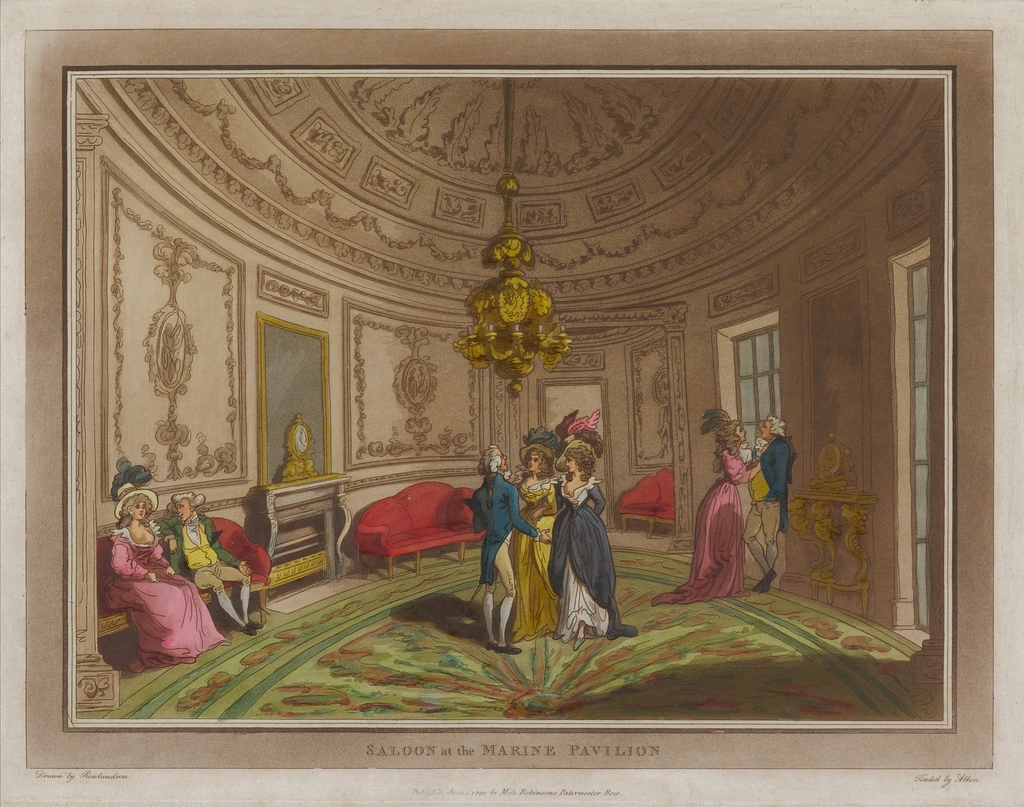
The Pavilion had been conceived for a bachelor prince and developed by a king with no children at home. Its plan reflects that. The state rooms are magnificent and the private apartments are modest; the building is arranged for entertaining rather than for family life. There are no nurseries in any meaningful sense, no schoolrooms, no wing that can be shut off and lived in quietly while the rest of the house does something else.
George IV had also wanted to be looked at. Regency Brighton was a stage for a court that enjoyed being seen arriving, riding, dining and gossiping, and the Pavilion was designed to be conspicuous. Victoria wanted the opposite. Her household was domestic in a way her uncle’s had never been, and the qualities that made the Pavilion an excellent house for a Regency prince made it an awkward one for a young married couple with a nursery full of children.
The Visits of a Reign
The first visits as queen
Victoria came to Brighton within months of her accession, when she was still unmarried and the novelty of a young queen brought crowds into the streets. Those early visits were reasonably successful. The town turned out, the Pavilion functioned as a reception house, and the occasion had the character of a public appearance rather than a holiday.
The family visits of the 1840s
The visits made with Prince Albert and the children in the 1840s were a different matter, and they settled the question. The royal party found the house cramped for its purposes and the town oppressive. The Queen’s last stay was early in 1845, and after it the family did not return. What followed was not a dramatic renunciation but a quiet administrative process: a house that was not used became a house that could not be justified, and a house that could not be justified was eventually sold.
The Privacy Problem
The single most important fact about the Royal Pavilion, for anyone trying to understand why the monarchy left it, is where it stands. It is not on the seafront. It is not at the end of a drive, behind a park, screened by trees, at the centre of an estate of its own. It sits a few streets inland, hemmed in by the town on almost every side, and by the 1840s that town had grown considerably since Nash finished work on the building.
The practical consequences were unavoidable.
- No approach of one’s own. Arriving and leaving meant passing through public streets in full view, with no long private drive on which to be unobserved between the carriage and the door.
- Grounds that were overlooked. The gardens are generous by the standards of a town centre but small by the standards of a royal residence. Children could be walked in them, but not without an audience beyond the railings.
- No sea and no prospect. The Pavilion has almost no view. Its pleasures are internal, which suits a house built for evening entertainment and frustrates a family that wants to be outdoors.
- A resort that never closed. Brighton’s whole economy depended on visitors, and visitors came to see whatever there was to see. A royal family in residence was the principal attraction in town.
The last point had been made much worse by an event outside anyone’s control. The railway from London reached Brighton in 1841, and the number of people able to get to the town cheaply and quickly multiplied. Where George IV’s Brighton had been crowded with people who had the means to travel, Victoria’s Brighton was crowded with everybody. A monarch who found the streets uncomfortable in the 1830s found them impossible a decade later.
The Building Itself
Victoria’s dislike of the Pavilion’s decoration is well attested and should not be dismissed, but it belongs after the practical objections rather than before them. The interiors were designed to astonish, in a manner that had already come to seem theatrical and slightly disreputable by the 1840s. Serpents, dragons, lacquer, gilding and imitation bamboo read to a later generation as the taste of a spendthrift regency rather than of a serious court.
There was also the awkwardness of inheritance. The Pavilion was inescapably her uncle’s house, saturated with his personality and associated with a style of royal life that Victoria and Albert were deliberately setting themselves against. Keeping it would have meant endorsing it. Leaving it — and eventually selling it — drew a line under the Regency more effectively than any speech could have done.
Where the Court Went Instead
Osborne
The replacement for Brighton was found on the Isle of Wight, where the royal couple acquired an estate in the mid-1840s and rebuilt the house there in an Italianate manner to their own requirements. Osborne answered every complaint the Pavilion had provoked. It had land around it, a private beach, a view of the sea, room for children and space for a household to spread out. Reaching it required a crossing, which discouraged casual sightseers. It was, in the exact sense of the word, a retreat.
Balmoral
The Highland estate followed within a few years, leased in the late 1840s and bought outright in the early 1850s, with a new house built shortly afterwards. Balmoral took the same logic further: distance as a form of privacy, landscape as a substitute for the streets. Between them the two purchases redefined the geography of the British court. The seaside pleasure palace was replaced by the island villa and the Scottish shooting lodge, and the pattern held for the rest of the reign.
What It Meant for Brighton
The town might have been ruined by the departure. In the event it barely noticed, because the railway had already supplied a new kind of visitor in numbers no court could match. Brighton stopped being a resort defined by royal patronage and became a resort defined by volume — excursions, lodging houses, piers, entertainment. The loss of the monarchy mattered far less economically than it would have done a generation earlier.
What the town gained was the building. Had Victoria enjoyed Brighton, the Pavilion would have remained a working royal residence, altered by successive occupants and closed to the public for most of the year. Because she did not, it was sold as architecture, and a municipal body acquired a complete Regency interior at the precise moment when nobody else particularly wanted one. The Pavilion survives in something like its original form partly because a queen found it embarrassing.
Reading the Story on Site
Visitors can test the argument for themselves without leaving the grounds. Stand on the east lawn and notice how close the surrounding buildings press in; walk the perimeter and count how few points there are at which the house is not overlooked from a street or an upper window. Then consider the private apartments on the upper floor, which are small, plain and clearly secondary to the state rooms below.
A guidebook can tell you that Victoria disliked the Pavilion; the site itself explains why in about ten minutes, and rather more convincingly.