A style that was never meant to be accurate
Step into the Royal Pavilion and the first thing that has to be said about the interiors is that they are not Chinese. They are chinoiserie: a European style that borrowed Chinese motifs, rearranged them according to European ideas of composition, and used them to make rooms that no Chinese patron would have recognised. That is not a criticism, or not only a criticism. It is the key to understanding what you are looking at. The Pavilion is one of the last and by far the most ambitious flourishes of a taste that had been amusing Europe for well over a century, and it is worth knowing where that taste came from before deciding what to make of it.
What chinoiserie actually is
The word comes from the French for Chinese, and it describes decorative work made in Europe in an imagined Chinese manner. Its vocabulary is easy to list: pagoda roofs and upturned eaves, dragons and phoenixes, bamboo real or imitated, lattice and fretwork, mandarins in wide-sleeved robes, parasols, cranes, peonies, lotus, rocks and improbable bridges. Its rules, however, are European. Chinoiserie loves asymmetry, surprise and lightness; it flourished alongside the rococo and shared its taste for the curved line and the pretty conceit.
Genuine Chinese art of the same period is a different proposition altogether, governed by long scholarly traditions, by conventions of brushwork and inscription, and by symbolism that carries specific meanings. When a Chinese painter placed a crane beside a pine, it meant something. When a London decorator did the same, it meant that a crane and a pine looked well together. The difference is not one of quality but of purpose. Chinoiserie was never trying to be Chinese art. It was trying to be delightful, and to signal that its owner had access to the exotic.
The trade behind the fantasy
What actually arrived
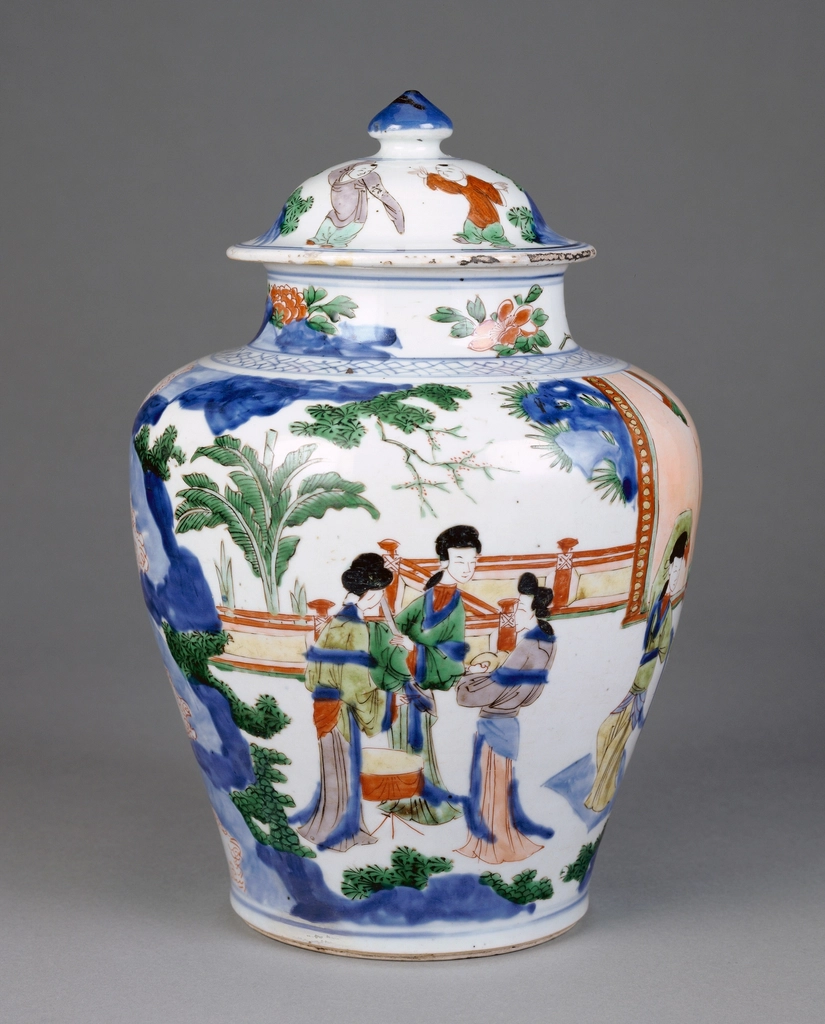
Behind the fantasy was a very real commerce. From the seventeenth century onwards, European trading companies brought back porcelain, lacquer screens, silk, wallpaper and, above all, tea. A great deal of it was made specifically for export, in workshops that had learned what European buyers wanted: armorial dinner services, shapes copied from European silver, decoration adjusted to European taste. So even the authentic imports were already part of the way to being a hybrid.
What did not arrive
Very few Europeans had seen China. Trade was restricted to a small number of ports, foreign merchants were confined and closely supervised, and the diplomatic embassies that were sent came home largely empty-handed. Into that gap rushed engravings, travellers’ tales, missionary accounts and a good deal of pure invention. Designers copied from each other far more often than from anything Chinese. By the time a motif reached a Brighton workshop, it might be a copy of a print of a painting of an object made for export — four removes from anything a Chinese craftsman would have called his own.
Why Regency Britain wanted it
- It signalled wealth and reach. Chinese goods were expensive and hard to obtain. A room full of them announced that its owner belonged to a nation whose ships went everywhere and whose money bought anything.
- It offered relief from classical seriousness. Georgian public taste was dominated by columns, pediments and the authority of Greece and Rome. Chinoiserie was the holiday from all that, which is why it turns up so often in bedrooms, tea rooms, garden buildings and seaside retreats rather than in courts of law.
- It suited a pleasure palace. Brighton was where the Prince Regent went in order to stop being official. A style associated with amusement rather than gravity was exactly right for a house built around dinner, music and conversation.
- It flattered the lighting of the day. Gilded surfaces, lacquer, mirror glass and painted foliage come alive under oil lamps and, later, under gas. The style was designed for evening effect, and it still reads best when the light is low.
How the Pavilion came to be Chinese inside
The story usually told is that a gift of Chinese wallpapers arrived early in the century and prompted the Prince to have a room decorated in the Chinese taste. Whether or not that is the whole explanation, the Chinese interiors began while the building was still Henry Holland’s neat classical villa, and they went on being extended and revised for the best part of twenty years. By the time John Nash gave the exterior its Indian-influenced domes and minarets, between 1815 and 1823, the inside and the outside had settled into a deliberate mismatch: an Indian silhouette wrapped around Chinese rooms. Contemporaries noticed. The Prince did not mind.
Frederick Crace
The decoration of the Chinese interiors was dominated by the firm of Crace, and by Frederick Crace in particular. The Craces were decorators in the full sense: they designed schemes, supplied and supervised the painters, gilders and japanners, and saw the work through to the last coat. Crace’s hand is clearest in the Music Room and along the Long Gallery, where the invention is relentless. Bamboo that is really painted iron or carved wood, landscapes in gold on crimson, canopies, dragons, and a palette that moves from soft pinks and blues in the corridors to full theatrical red and gold in the great rooms.
Robert Jones
Robert Jones is the other name to remember, and the Banqueting Room and the Saloon are the places to look for him. His manner is heavier and more sculptural than Crace’s: large painted figure scenes, bold modelled ornament, dragons treated as structure rather than as pattern. Between them the two designers gave the Pavilion its range, from the delicate to the frankly overwhelming, and part of the pleasure of a visit lies in learning to tell one from the other.
How to look at these rooms now
Modern visitors sometimes arrive with a worry: is it acceptable to enjoy rooms built out of a European fantasy of Asia? It is a fair question, and the museum no longer ducks it. A few habits of looking help.
First, read the rooms as evidence about Britain rather than about China. They tell you what Regency Britain wanted Asia to be: decorative, amusing, endlessly available and safely distant. That is a historical fact about the people who made them, and it sits inside a much larger history of trade, profit and empire that the same generation was busy expanding.
Second, give the craftsmanship its due. Whatever one thinks of the conceit, the execution is extraordinary. The carving, the graining, the japanning, the glasswork and the gilding were done by British workshops at the top of their form, and a great deal of what you see has been painstakingly recovered by conservators working from the original accounts and designs.
Third, notice the sequel. In the First World War the Pavilion was used as a hospital for wounded Indian soldiers, and photographs from that period show men lying beneath Crace’s dragons. The building’s eastern dress was made much of at the time. A fantasy of Asia, built for a prince’s amusement, became a real ward for real men from the countries it had imagined. It is worth holding those two facts together as you walk through.
What to look for on the day
- The fakery is the point. Test the bamboo with your eye. A great deal of it is carved wood or painted metal, and the skill lies in the imitation rather than in the material.
- Follow the palette. The corridors are pale and cool; the state rooms are hot. The sequence is stage-managed so that each great room arrives as a shock after the passage that leads to it.
- Look up, then look down. Ceilings carry the boldest invention, but the floors, chimneypieces, door furniture and window fittings repay attention too, and they are where the Craces show their range.
- Ask what is original. Much was sold or removed after the building passed to the town, and has since been returned, replicated or reconstructed. The interpretation is honest about which is which, and the distinction is genuinely interesting.
- Compare the two designers. Spend a few minutes in the Music Room and then in the Banqueting Room with the difference between Crace and Jones in mind, and both rooms sharpen considerably.