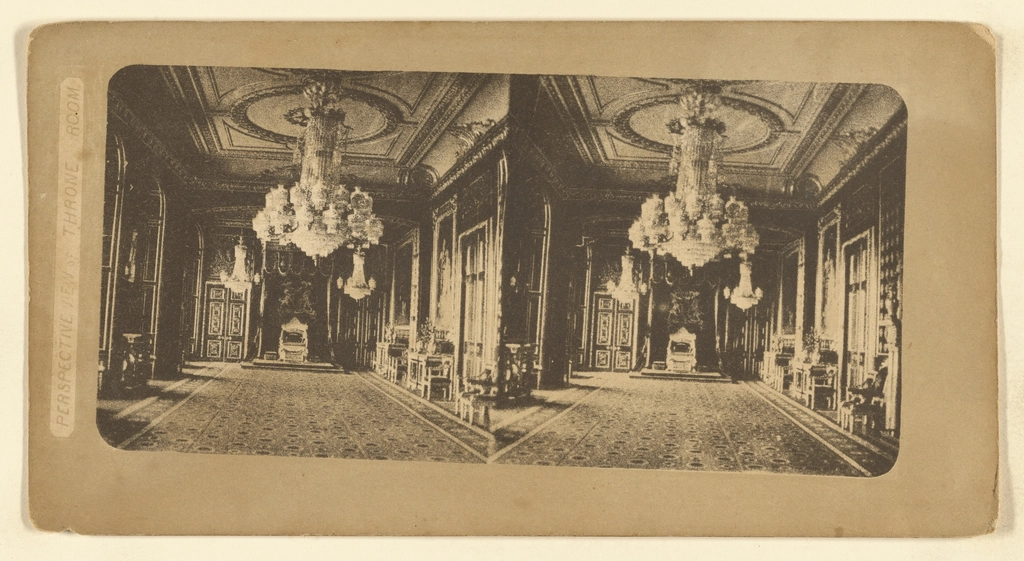
A building that behaves like a portrait
Most great houses tell you about a dynasty. The Royal Pavilion tells you about a single man, and it tells you rather more than he probably intended. Almost everything in it — the domes and minarets outside, the dragons and lacquer and crimson within, the sheer accumulated expense of the thing — came from the taste and the appetite of George Augustus Frederick, Prince of Wales, then Prince Regent, then George IV. The architects were working for a client who knew exactly what effect he wanted, and who kept wanting more of it. To understand the Pavilion, it helps to understand him.
The young prince who came to the sea
George was born in 1762, the eldest son of George III and Queen Charlotte, and he grew up in a court of rigid routine and moral seriousness that he spent the rest of his life reacting against. He first came to Brighton in the early 1780s, in his early twenties, joining an uncle who was already part of the town’s fashionable set. The stated reason was health: the sea-water cure was then at the height of its medical reputation, and the prince was said to suffer from swollen glands of the neck, exactly the complaint the cure was supposed to relieve.
The real attraction was that Brighton was small, cheerful, some fifty miles from his father, and full of people willing to be entertained. He took a farmhouse on the Steine, and within a few years had asked the architect Henry Holland to turn it into a neat neo-classical villa: the Marine Pavilion, all restrained cream stucco and a shallow dome, a building that would astonish nobody today. Everything exotic came later.
A secret marriage and a mountain of debt
Maria Fitzherbert
In 1785 the prince went through a marriage ceremony with Maria Fitzherbert, a twice-widowed Catholic gentlewoman six years his senior. The marriage was invalid twice over in law — the Royal Marriages Act required the king’s consent, which was never sought, and the Act of Settlement penalised marriage to a Catholic — but it was real to her, and by most accounts real to him. It was also an open secret, denied in Parliament by his friends while the whole of fashionable London discussed it. Mrs Fitzherbert lived in Brighton for years, in her own house a short walk from the Pavilion, and the town absorbed the arrangement with a shrug that says a good deal about the place.
The price of the debts
The prince spent on a scale that repeatedly forced the government’s hand. Building, pictures, furniture, horses, clothes, gambling and the maintenance of a rival court all ran far beyond his income, and by his early thirties his debts were a political scandal. The settlement that followed was brutal in its logic: Parliament would relieve him if he married suitably and produced an heir. In 1795 he married his cousin Caroline of Brunswick, a marriage that failed within weeks and poisoned both their lives. Their only child, Princess Charlotte, was born the following year and died in childbirth in 1817, a national grief that left the succession to the prince’s brothers and, eventually, to his niece Victoria.
A collector before he was a king
Set the debts beside what the money bought and the picture complicates. George was one of the most serious collectors ever to sit on the British throne. He bought Dutch and Flemish cabinet pictures with real discrimination, and French furniture, porcelain and gilt bronze on a scale that helped make the royal collection what it is. He commissioned portraits from Thomas Lawrence, including the series of allied statesmen and commanders painted after the defeat of Napoleon. He gave his father’s great library to the nation, and he pressed for the public purchase of pictures that became the founding core of the National Gallery.
He was also a compulsive builder. Carlton House in London, Windsor Castle in its present romantic silhouette, the transformation of Buckingham House into a palace, and the Pavilion itself all belong to him. What looks like extravagance from the Treasury’s side of the ledger looks, from the museum’s side, like patronage of unusual persistence.
Regent, then king
When George III’s condition became permanent, his son was made Prince Regent in 1811 and ruled in his father’s name for nine years before succeeding as George IV in 1820. The Regency coincided with the last years of the Napoleonic wars, the hard peace that followed, and serious domestic unrest — a decade in which a monarch conspicuously spending on an oriental pleasure house by the sea was an easy target.
It was precisely in these years that John Nash rebuilt the Pavilion, between about 1815 and 1823, wrapping Holland’s villa in the Indian-influenced skyline of domes, minarets and pierced stonework that visitors see today. The great state rooms were finished and refinished while the country argued about bread prices. George came to Brighton less often after his accession, and his last visits fell in the closing years of the 1820s; by then he was in poor health, sensitive about his appearance, and increasingly withdrawn. He died in 1830, and neither of his successors wanted the Pavilion. Queen Victoria, who found it short of privacy and short of sea view, sold the building to the town of Brighton in 1850 — an act of royal indifference that turned a private palace into a public one.
The reputation he had in his own time
Few public figures have been so mercilessly drawn. The caricaturists of the age — Gillray, the Cruikshanks and their many imitators — made his bulk, his corsets, his mistresses and his debts into a national joke, and the joke stuck. The public humiliation of his attempt to divorce Queen Caroline in 1820 turned crowds against him in London. When he died, the obituaries were notably ungenerous; one leading newspaper suggested that no one had ever been less mourned.
Some of this was deserved. He was self-pitying, evasive about money, unkind to his wife and unreliable to his political friends. Some of it was the ordinary cruelty of a satirical culture that needed a fat prince, and some of it was partisan: he had begun as the darling of the Whig opposition and ended by disappointing them.
How historians have revised him
- The patron outlasts the spendthrift. Twentieth-century biographers, working through the accounts and the correspondence rather than the cartoons, found a client with genuine judgement, whose purchases and commissions repay study on their own merits.
- The politics were harder than the caricature allows. His room for manoeuvre as Regent was narrower than his critics assumed, and his eventual acceptance of measures he disliked, including Catholic emancipation, mattered.
- Illness and pain are now taken seriously. His later years involved gout, breathlessness and heavy medication, which helps explain the seclusion that contemporaries read simply as indolence.
- The buildings are the argument. Windsor, the shape of central London around Regent Street, and the Pavilion are a substantial legacy, and the case for him now rests largely on what he left standing.
None of this makes him admirable in the way a Victorian moralist would want. It does make him interesting, and it makes the Pavilion legible as something other than a folly.
Reading the Pavilion as a self-portrait
Walk the state rooms with the man in mind and the building starts to explain itself. The exterior is theatre, designed to be seen from the Steine by a public that was not invited in. The interiors are inward-looking, artificially lit, elaborately serviced, arranged for a small circle enjoying itself at length. The Chinese fantasy is not scholarship but appetite, assembled from imported wallpapers, export porcelain and the imagination of designers who had never travelled east. The Indian exterior and the Chinese interior do not match, and were never meant to; the point was effect, not consistency.
There is vulnerability in it too. A building this determined to delight is a building made by someone anxious about how he was seen. He was mocked for it in his lifetime and is thanked for it now. If you want the shortest summary of George IV, it is that he was a poor king and an extraordinary client, and that Brighton has been living off the difference for two hundred years.