The Gardens Are Part of the Design, Not a Setting
Most visitors walk through the Pavilion Gardens on the way to the entrance and out again afterwards, treating them as the space around the building. They were designed as an integral part of it, and they are among the more interesting historic gardens in southern England.
They are also free, open daily, and pleasant in every season — which makes them the most overlooked thing on the site.
What Nash Intended
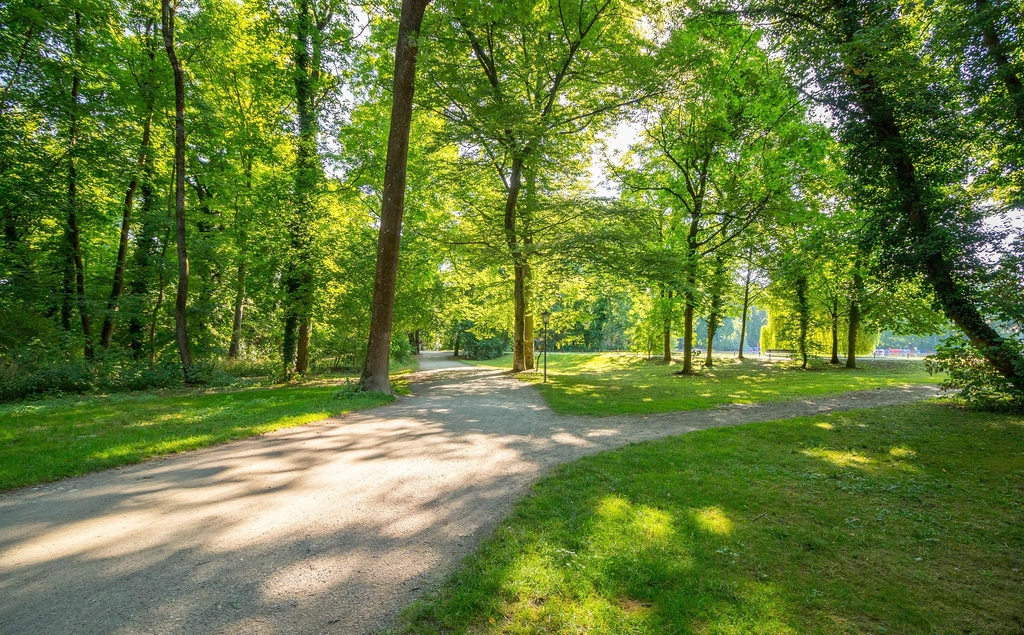
John Nash laid out the grounds at the same time as he remodelled the building, and the two were conceived together. The style was picturesque: winding paths, irregular planting, shrubs in generous groups, and carefully framed views that reveal the building gradually rather than all at once.
This was a deliberate rejection of the formal geometry that preceded it. Nothing lines up. Paths curve for no functional reason. Planting is layered so that the domes appear through foliage rather than across a lawn.
- Approach from the north for the sequence Nash designed, with the building emerging between planting.
- Notice the layering — low shrubs, taller shrubs, then trees, arranged to create depth in a small space.
- Look for the framed views, where a gap in planting reveals a specific part of the building.
A Restoration Based on Evidence
By the twentieth century the gardens had been simplified into municipal lawns and bedding. The restoration that began in the 1980s is unusual in being grounded in documentary evidence rather than general period style.
Nash published views of the gardens, and his planting notes survive. Combined with archaeological work on path lines and soil analysis, this allowed the gardens to be returned to something close to their original planting, using species available in the 1820s.
The result is a genuine Regency garden rather than an approximation, and it is one of very few in the country restored to this standard.
Through the Seasons
- Spring brings bulbs beneath the shrubs and the first structure of the borders becoming visible.
- Summer is the fullest, and the layered planting reads exactly as intended, with the domes half-hidden.
- Autumn gives the best colour and the clearest light for photography.
- Winter strips the planting back and reveals the path structure and the building itself — the season to understand the layout.
Wildlife in the Middle of Town
The gardens support more life than their size suggests, largely because the planting is dense and varied and the site has been continuously gardened for two centuries.
Mature trees hold nesting birds, and the mixed shrub layer provides cover in a town otherwise short of it. Management has moved towards fewer chemicals and more tolerance of untidiness, which has increased insect numbers noticeably. For a garden hemmed in by roads on all sides, it does a considerable amount of ecological work.
Using the Gardens Well
- Arrive early for the quietest hour of the day, before the town wakes.
- Walk the perimeter first, then cut through — the outer path shows the building from every angle.
- Bring lunch. There are benches, and it is a considerably better spot than most in central Brighton.
- Look at the ground. The path surfaces and edging are part of the restoration and easy to walk over without noticing.
A Free Introduction
If you are undecided about paying to go inside, spend half an hour in the gardens first. They give a clear sense of the ambition of the place, they cost nothing, and they are the part of the site most people remember once the gilding has blurred together.
They are also the reason the Pavilion still reads as a palace rather than a curiosity stranded in a city centre — and that was exactly what Nash intended.
How the Gardens Fit the Wider Town
Central Brighton has very little green space, and what exists is mostly small and hard-surfaced. The Pavilion Gardens are among the largest continuous planted areas in the town centre, which gives them a role well beyond their historic interest.
They function as a route as much as a destination — a green crossing between the shopping streets and the museum quarter that thousands of people use daily without stopping. That constant footfall is a challenge for a restored historic garden, and the balance struck between public use and conservation is a large part of why the planting is arranged as it is.
Reading a Regency Garden
A few conventions of the period, once known, make the layout legible.
- Irregularity is deliberate. Nothing is symmetrical, because symmetry belonged to the formal style the picturesque was reacting against.
- Shrubberies do the structural work that hedges do in a formal garden, dividing space without hard edges.
- Paths are routes of discovery, curving so that what lies ahead is concealed until you reach it.
- Planting is in drifts, with species repeating along a border rather than appearing once.
- Lawn is a surface between plantings, not the main event as it became later in the century.
If You Have Only Twenty Minutes
Enter from the north gate, walk the outer path clockwise to the eastern side where the building is seen through planting, then cut diagonally back across towards the domes. That short circuit covers the intended sequence of views and gives you the building from the three angles Nash cared most about.
Do it once in summer and once in winter, and you will understand the garden better than most people who have walked through it for years.